
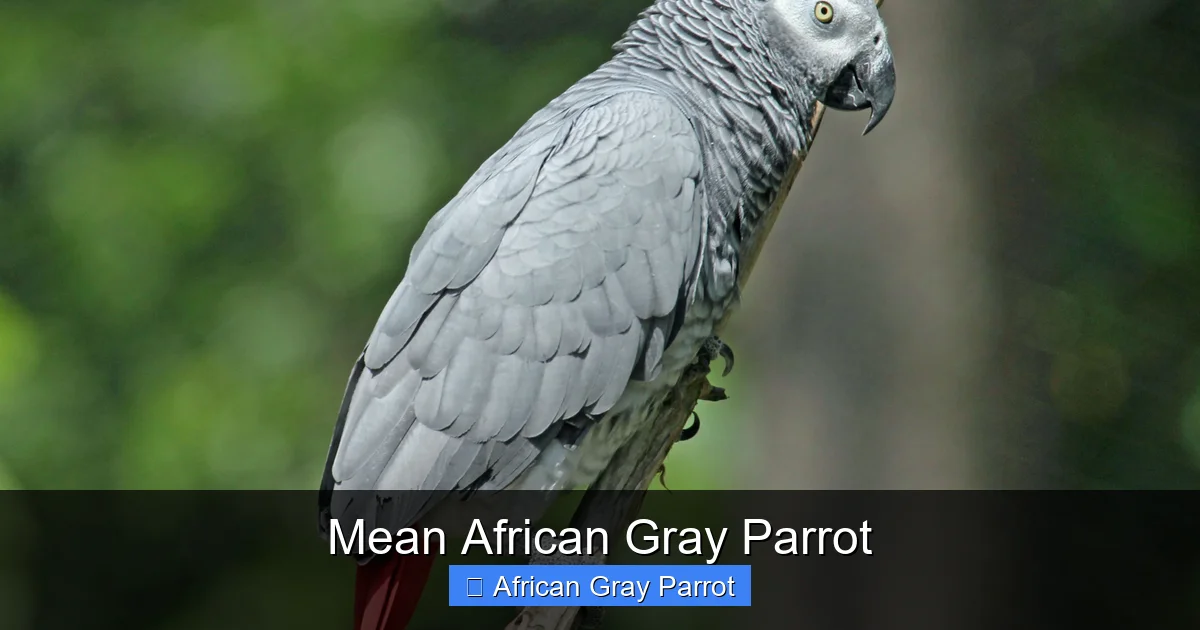
A mean African Grey parrot isn’t born aggressive — fear, hormones, or past trauma usually drive the behavior. With consistent training, environmental changes, and trust-building, you can transform a biting, screaming bird into a loving companion.
You reach into the cage to change the water dish. Suddenly — snap. Your African Grey latches onto your finger like a tiny vice. Blood wells up. Your heart races. You pull back, stunned. “But he loves me,” you think. “Why is he being so mean?”
Here’s the truth: there’s no such thing as a mean African Grey parrot. Not really. What looks like meanness is almost always fear, frustration, hormonal surges, or a cry for help. These birds are among the smartest animals on Earth. They feel deeply. They remember everything. And when they bite, scream, or lunge, they’re telling you something important — if you know how to listen.
Key Takeaways
- Aggression is communication: A mean African Grey parrot is usually scared, hormonal, or in pain — not “bad.”
- Identify triggers first: Track when bites happen to spot patterns like cage territoriality or hormonal seasons.
- Never punish physically: Hitting or yelling destroys trust and makes aggression worse over time.
- Use positive reinforcement: Reward calm behavior with treats, praise, or head scratches to build new habits.
- Respect body language: Pinned eyes, flared tail, and growling mean “back off” — listen before you reach.
- Hormones play a huge role: Spring breeding season often turns sweet birds mean — adjust lighting and diet to help.
- Consistency wins: Short daily training sessions beat occasional long ones for lasting behavior change.
Quick Answers to Common Questions
Why is my African Grey suddenly biting me?
Sudden biting usually signals pain, hormonal changes, fear from a recent event, or accidental reinforcement of past nips. Rule out medical causes first with an avian vet visit.
Can a mean African Grey become friendly again?
Yes. With consistent positive reinforcement training, trigger management, and trust-building, almost any aggressive Grey can become a loving companion. It takes months, not days.
Should I wear gloves to handle my aggressive African Grey?
Use gloves only for necessary medical care or emergencies. Daily handling with gloves teaches the bird that biting has no consequence and prevents learning gentle beak pressure.
How do I stop my African Grey from being cage aggressive?
Train stationing on a perch outside the cage for maintenance. Use target sticks to move the bird. Never reach into a defensive bird’s cage. Respect the cage as their sanctuary.
Is my African Grey mean because he hates me?
No. Parrots don’t feel hate. Aggression comes from fear, hormones, pain, resource guarding, or learned behavior. Your bird is communicating distress, not malice.
📑 Table of Contents
Understanding African Grey Parrot Behavior
African Greys don’t do “mean.” They do survival. In the wild, a bird that hesitates gets eaten. A bird that doesn’t defend its nest loses its babies. Every behavior you see — the biting, the screaming, the cage aggression — has roots in instincts that kept their ancestors alive for millions of years.
Intelligence Changes Everything
Your Grey has the cognitive ability of a 4- to 5-year-old human child. Let that sink in. A toddler with a beak strong enough to crack brazil nuts. A toddler who remembers that you left for three days last month. Who noticed you favored the other bird yesterday. Who feels jealousy, grief, boredom, and love with startling intensity.
This intelligence means they think. They plan. They hold grudges. They test boundaries. And they manipulate — not out of malice, but because they’ve learned what works. If biting makes the scary hand go away, they’ll bite again. If screaming brings you running, they’ll scream more.
Prey Animal Instincts
Never forget: parrots are prey animals. Their first instinct is flight. When flight isn’t an option — like inside a cage — fight kicks in. That cage? It’s not a home to them. It’s a trap with bars. When you reach in, you’re a predator invading their only sanctuary.
This is why cage aggression is so common. Your bird isn’t “territorial” in a human sense. They’re defending their survival space. The same bird who cuddles on your shoulder may turn into a demon when you touch their cage door. Different context. Different rules.
Social Needs Run Deep
Wild Greys live in flocks of hundreds. They’re never alone. Ever. Isolation is a death sentence. Your single pet bird sees you as their flock. When you leave for work, they don’t understand “job” or “money.” They only know their flock abandoned them. That grief comes out as destruction, screaming, or aggression when you return.
Why Your African Grey Might Act Mean
Let’s break down the most common reasons behind aggressive behavior. Your bird probably fits several of these.
Fear and Past Trauma
Rescue birds often carry invisible scars. The Grey who lunges at men wearing hats? Maybe a man in a hat once swung a broom at him. The one who screams when you raise your voice? Perhaps yelling preceded abuse in a previous home. These birds have long memories. A single bad experience can create a lifelong trigger.
Even well-raised birds develop fears. A fallen toy that startled them. A vet visit with towels and needles. A thunderstorm that shook the windows. Fear bites are defensive — fast, hard, and without warning signs you recognized.
Hormonal Surges
Spring brings chaos. Lengthening days trigger breeding instincts. Your sweet companion suddenly regurgitates on toys, shreds paper into nests, and attacks anyone near “their” chosen mate — which might be you, a toy, or the other bird. Males and females both get hormonal. It’s not “bad behavior.” It’s biology.
During this season, even experienced owners get bitten. The bird isn’t choosing to be mean. Their brain is flooded with hormones that scream protect the nest. This passes. But how you handle it determines whether it becomes a learned habit.
Pain and Illness
Birds hide sickness instinctively. A sick bird in the wild gets targeted by predators. So your Grey acts normal until they literally can’t. But chronic pain — arthritis, feather cysts, dental issues, GI problems — makes anyone irritable. A bird who bites when you touch their back might have kidney issues. One who snaps at foot handling could have bumblefoot or arthritis.
Rule of thumb: Sudden personality change means vet visit. Always.
Lack of Sleep
Greys need 10–12 hours of dark, quiet sleep. Most get 6–8 with TV noise, lights, and family activity. Chronic sleep deprivation makes them cranky, reactive, and bite-prone. It’s exactly like a toddler who missed their nap — except the toddler has a nutcracker for a face.
Boredom and Understimulation
A brilliant mind with nothing to do creates its own entertainment. Often destructive entertainment. Screaming for attention. Biting to get a reaction. Feather plucking. These aren’t “behavior problems.” They’re symptoms of a brain starving for challenge.
Accidental Reinforcement
This one hurts. You taught the biting. Not on purpose. But when your bird nipped, you pulled back — teaching them biting works. When they screamed, you came running — teaching them screaming works. When they lunged, you said “no!” loudly — teaching them lunging gets attention. Birds don’t understand “negative” attention. Attention is attention.
Common Triggers for Aggressive Behavior
Knowing why helps. Knowing when helps more. Start a behavior log. Note time, location, activity, body language, and what happened right before. Patterns emerge fast.
Cage Territoriality
The number one trigger. Reaching into the cage. Changing food bowls. Cleaning perches. Moving toys. Your bird sees this as home invasion. Signs: pinned eyes, lowered head, growling, lunging at the door, striking through bars.
Fix: Train stationing on a perch outside the cage for maintenance. Use a target stick. Never force hands inside a defensive bird’s cage.
Shoulder Time Gone Wrong
Shoulder sitting seems sweet. But it puts a reactive bird at face level with zero escape route. A sudden noise — a sneeze, a phone ring — triggers a bite to the ear, nose, or lip. Many severe facial injuries start this way.
Fix: Hand or forearm perching only. Shoulder time earned through calm behavior, not default.
Resource Guarding
Food bowls. Favorite toys. A specific perch. You. Greys guard resources fiercely. Approaching a guarded item triggers instant aggression. This includes “mate guarding” — attacking anyone who approaches their chosen person.
Fix: Trade games. Offer something better for the guarded item. Never just take. Build trust that giving things up means good things happen.
Hormonal Triggers
Long daylight hours. Warm mushy foods. Petting on the back, under wings, or near the vent. Nest-like spaces (boxes, tents, under furniture). A perceived “mate” (you, a mirror, another bird). All scream “breeding season” to a Grey’s brain.
Fix: 10–12 hours darkness. No warm mushy foods. Head-only petting. Remove nest-like spots. Discourage regurgitation by calmly walking away.
Stranger Danger
New people. New pets. New furniture. A hat. Glasses. A beard. A different colored shirt. Greys notice everything. Changes equal potential threats. Threats equal defensive aggression.
Fix: Slow introductions. Let the bird observe from distance. Treats from strangers. Never force interaction.
Overstimulation
Too much petting. Too loud. Too long. Too many people. Greys have a threshold. Past it, they bite to say “stop.” Warning signs get subtle: feather slicking, quick head turns, skin tightening around eyes, tail fanning.
Fix: Short sessions. Watch body language. Stop before the bite. End on a good note.
How to Handle a Mean African Grey Parrot
Right now. Today. When the bird is lunging at you.
Stay Calm — Always
Easier said than done when blood drips from your finger. But your reaction teaches. Yelling, jerking away, hitting, squirting water — these all escalate. The bird learns: humans are unpredictable and dangerous. Next time, they bite faster.
Instead: freeze. Breathe. Count to three. Slowly withdraw. No drama. No words. Put the bird down or step away. Tend your wound privately. Process your feelings later.
Read the Body Language
Greys speak clearly if you learn their language.
- Pinned eyes (rapid dilation/contraction): excitement, anger, or fear — context matters
- Flared tail feathers: arousal, aggression, or balance for a lunge
- Feathers slicked tight: fear, readiness to fly or bite
- Feathers puffed: relaxation — or illness if constant
- Head lowered, beak open: “come here” or “I’ll bite” — watch eyes
- Growling/hissing: “back off now”
- Wing drooping or quivering: fear or illness
- One foot raised: often relaxation, but context matters
- Beak wiping: cleaning, or displacement behavior when conflicted
Learn YOUR bird’s specific tells. They’re individuals.
Use Protective Gear Strategically
Thick leather gloves. Welding sleeves. A towel. These let you handle necessary care (medication, vet prep, emergency) without fear. Fear makes you hesitant. Hesitation makes you clumsy. Clumsiness gets you bitten more.
But — don’t use gloves for daily interaction. The bird needs to learn gentle beak pressure on bare skin. Gloves teach “bite hard, no consequence.”
Step-Up Training — The Foundation
Every interaction starts with “step up.” But a mean bird may refuse or bite the offered hand.
Target training first. Teach them to touch a chopstick or stick for a treat. No hands involved. Builds communication without conflict.
Then perch training. Offer a handheld perch. “Step up” onto wood, not skin. Safer for you. Less threatening for them.
Then hand training. Flat hand, fingers together, thumb tucked. Approach from below, not above. Let them choose. Reward heavily.
Never chase. Never force. If they say no, respect it. Try again in five minutes. Trust builds in the moments you don’t push.
Environmental Management
Set them up to succeed.
- Sleep cage in a dark, quiet room for 12 hours
- Main cage against a wall (not in traffic flow), with one side covered for security
- Multiple food/water stations to reduce resource guarding
- Foraging toys — every meal worked for, not bowl-fed
- Rotate toys weekly — novelty prevents boredom
- Natural perches of varying diameters for foot health
- UV lighting — supports hormone regulation and mood
- Visual barriers if cage mates fight
Diet Matters More Than You Think
Seed-only diets cause malnutrition, fatty liver disease, and hormonal spikes. High-sugar fruits fuel energy spikes and crashes. Warm, mushy foods mimic regurgitated mate-feeding — triggering hormones.
Feed: 60–70% high-quality pellets. 20–30% vegetables (dark leafy greens, orange veg, peppers). 10% fruits (berries best, limit tropical). Healthy nuts as training treats only. No avocado, chocolate, caffeine, alcohol, onions, salt.
Diet changes take months to show behavior shifts. But they’re foundational.
Training Techniques for Better Behavior
Training isn’t tricks. It’s communication. It’s a shared language. And it’s the fastest way to rebuild trust with a mean African Grey parrot.
Positive Reinforcement Only
Reward what you want. Ignore what you don’t. Never punish. Punishment suppresses behavior temporarily but destroys trust permanently. A suppressed bird is a ticking time bomb.
Marker training: Use a clicker or word (“yes!” or “good!”) to mark the exact second of desired behavior. Follow instantly with treat. The marker bridges the gap between action and reward.
Target Training — The Magic Tool
A target stick (chopstick, dowel, pointer) lets you guide movement without hands.
- Hold target near beak.
- Bird touches it (curiosity).
- Click. Treat.
- Repeat until deliberate.
- Move target — bird follows.
- Now you can guide them anywhere: off cage, onto scale, into carrier, away from conflict.
No force. No biting. Just a game they love.
Station Training
Teach “go to your spot.” A specific perch, mat, or platform. Reward heavily for staying there. This becomes their safe place during cage cleaning, guest visits, cooking, or any chaos.
Start with 3 seconds. Build to minutes. Always release with a cue (“free!” or “okay!”) so they learn duration has an end.
Trade Games for Resource Guarding
Bird has a toy. You want it back. Don’t take. Trade.
- Offer high-value treat (almond sliver, sunflower seed).
- Bird drops toy for treat.
- Click. Give treat. Return toy.
- Repeat until trade is automatic.
- Sometimes keep toy. Sometimes return. Bird learns giving things up isn’t loss.
Desensitization and Counterconditioning
For specific triggers: hands, towels, nail trims, strangers.
Example — towel fear:
- Towel visible across room. Bird calm. Click. Treat.
- Towel closer. Calm. Click. Treat.
- Towel on your lap. Calm. Click. Treat.
- Touch towel. Calm. Click. Treat.
- Drape towel on shoulder. Calm. Click. Treat.
- Lightly touch bird with towel corner. Click. Treat.
Tiny steps. Days or weeks per step. If fear returns, go back two steps. This rebuilds the emotional association: towel = good things.
Flight Recall — Ultimate Safety
Teach “come here” in flight. Start indoors, short distances. High-value rewards. This gives you a way to get them back if they escape — and builds off-leash trust.
Never chase a flying bird. It triggers prey drive. Call. Reward. Make returning the best game ever.
Short Sessions. Daily. Always End Well.
5 minutes. 3 times a day beats 30 minutes once. Birds have short attention spans. Quit while they’re winning. Last rep = easy win. Big jackpot reward. Session over.
When to Seek Professional Help
Some situations need expert eyes. Don’t wait until you’re injured or the bird is rehomed.
Avian Veterinarian First
Any sudden aggression. Any behavior change. Any bird who hasn’t had a wellness exam in a year. Blood work, radiographs, fecal exams reveal hidden pain, infection, hormonal imbalances, organ dysfunction. Treating medical causes often resolves “behavior” issues completely.
Certified Parrot Behavior Consultant
Look for IAABC certification or similar. Not a “bird trainer” — a behavior consultant. They assess the whole picture: environment, diet, history, human dynamics, species needs. They create a customized plan. They coach YOU, not just the bird.
Virtual consults work well. Many top consultants work worldwide via video.
Red Flags Requiring Immediate Help
- Bird draws blood regularly
- Attacks without warning signs
- Self-mutilation (feather destruction, skin chewing)
- Aggression toward specific family member (especially children)
- You feel afraid of your bird
- Considering rehoming
- Multiple birds fighting dangerously
What a Good Consultant Does
- Takes detailed history (2+ hours)
- Observes via video or in person
- Rules out medical with vet coordination
- Creates written behavior modification plan
- Teaches you mechanics and timing
- Provides follow-up support
- Adjusts plan as bird progresses
- Never uses punishment, flooding, or dominance theory
Support for YOU Matters Too
Living with a mean African Grey parrot is isolating. Exhausting. Heartbreaking. You love this bird. You’re trying everything. And it feels like nothing works.
Join parrot behavior communities (Facebook groups like “Parrot Behavior and Training,” “Applied Behavior Analysis for Parrots”). Find people who get it. Share the wins. Vent the losses. You’re not failing. You’re learning a complex skill with a complex being.
Building a New Relationship
Six months from now. You approach the cage. Your Grey watches. Pins eyes — but not the attack pin. The curious pin. You offer a target stick. They touch it. Click. Almond sliver. You open the door. Offer a perch. They step up. Calm. Confident. You walk to the play gym. They preen your shirt. Whisper “hello.” You laugh. They laugh back.
This happens. Not by magic. By thousands of tiny choices. Choosing patience over force. Choosing observation over assumption. Choosing to learn their language instead of demanding they learn yours.
The mean African Grey parrot wasn’t mean. They were misunderstood. And you — you became the human they could trust.
That’s the real reward. Not the lack of bites. The connection. The moment a wild, brilliant, traumatized soul looks at you and thinks: safe. This one is safe.
You’ve got this. One target touch at a time.
Frequently Asked Questions
How long does it take to fix aggression in an African Grey?
Most owners see meaningful improvement in 3–6 months with daily training. Deep-seated fear or trauma cases may take a year or more. Consistency matters more than intensity — 5 minutes daily beats hourly sessions once a week.
Can two African Greys live together if one is mean?
Sometimes. But introducing birds requires careful quarantine, slow visual access, and supervised interactions. A “mean” bird may redirect aggression toward a cage mate. Never house them together until both show calm, positive body language through barrier introductions.
What treats work best for training a bitey African Grey?
High-value, tiny treats: slivered almonds, pine nuts, sunflower seeds (shelled), dried chili peppers, or a specific pellet they love. Reserve these ONLY for training. The treat must be consumable in 1–2 seconds to keep momentum.
Why does my African Grey only bite one family member?
This is often mate guarding — the bird has bonded to one person and sees others as rivals. It can also stem from past negative experiences with that person’s gender, height, voice, or accessories (hats, glasses). Counterconditioning with that person giving all high-value treats helps.
Should I cover my African Grey’s cage when they’re aggressive?
Covering can reduce visual triggers and help sleep, but never use it as punishment (“time out”). A covered cage during the day increases frustration. Use covers only for 12-hour nighttime sleep in a dark, quiet room.
Can diet really change my African Grey’s aggression?
Absolutely. High-fat, high-sugar, seed-heavy diets fuel hormonal surges and energy spikes. Pellet-based diets with abundant vegetables stabilize blood sugar and reduce breeding behaviors. Diet alone won’t fix aggression, but it’s a critical foundation for behavior work.