
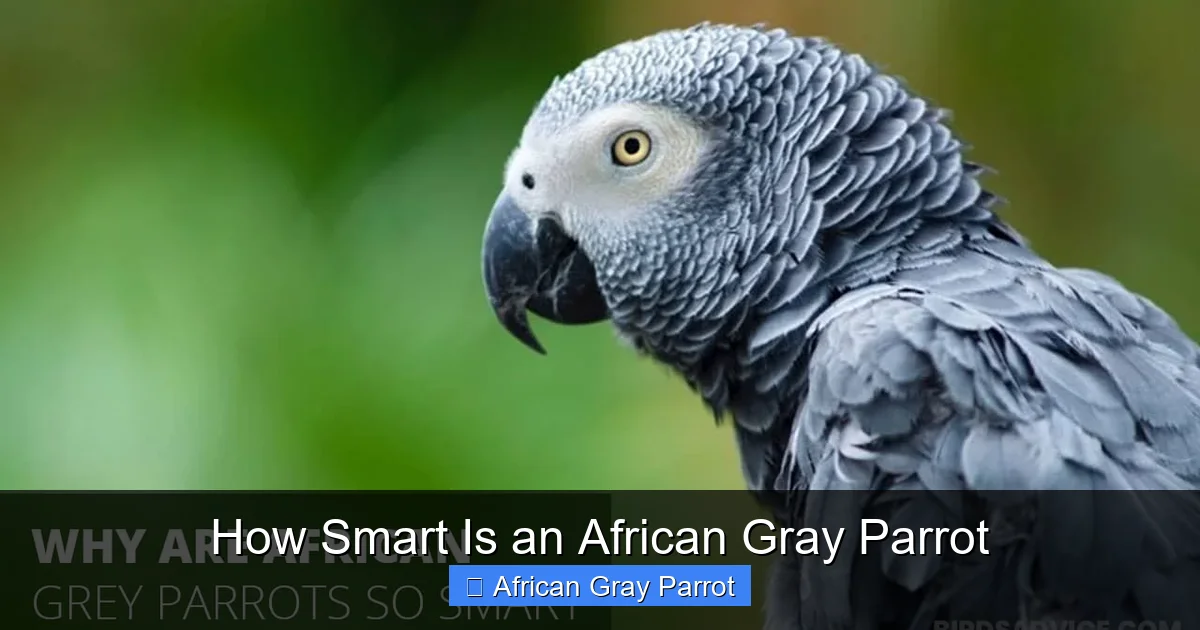
African gray parrots rank among the smartest animals on Earth, with cognitive abilities comparable to a 5-year-old human child. These remarkable birds demonstrate advanced problem-solving, extensive vocabulary use, emotional intelligence, and even basic mathematical concepts.
If you have ever spent time around an African gray parrot, you already know the answer. These birds are scary smart. They do not just repeat words. They use them. They solve puzzles. They manipulate their owners. They seem to understand concepts that should be beyond a bird. The question how smart is an African gray parrot has fascinated scientists and bird lovers for decades. The short answer is very smart. The long answer is fascinating.
African gray parrots sit at the very top of the avian intelligence hierarchy. Researchers consistently rank them alongside corvids like crows and ravens. Some studies place their cognitive abilities on par with great apes and human toddlers. This is not anecdotal. It is backed by rigorous, peer-reviewed science spanning over thirty years. The most famous proof comes from a single bird named Alex. But the story goes much deeper than one famous parrot.
In this guide, we will break down the science of African gray intelligence. We will look at brain structure, landmark studies, language capabilities, problem-solving, emotional depth, and what this means if you share your home with one. Whether you are a curious animal lover or a current parrot parent looking for enrichment ideas, you will find the answers here.
Key Takeaways
- Exceptional cognitive abilities: African gray parrots possess intelligence comparable to great apes and young children, with advanced problem-solving and reasoning skills.
- Language mastery: They can learn hundreds of words and use them in appropriate context, not just mimicry.
- Proven by science: The famous Alex studies by Dr. Irene Pepperberg provided rigorous scientific evidence of parrot intelligence over 30 years.
- Emotional depth: These birds show empathy, form deep bonds, and understand the perspectives of others.
- Tool use and innovation: African grays can solve multi-step puzzles and use tools to obtain rewards.
- High maintenance pets: Their intelligence demands constant mental stimulation, social interaction, and enriched environments.
- Long-term commitment: With lifespans of 50-60 years, owning an African gray is a multi-decade responsibility requiring dedicated care.
Quick Answers to Common Questions
How many words can an African gray parrot learn?
An average pet African gray learns 50 to 200 words, while exceptional individuals can master 500 to over 1,000 words with consistent training and social interaction.
Do African gray parrots understand what they are saying?
Yes, research shows they use words contextually to label objects, express desires, answer questions, and combine concepts, demonstrating comprehension beyond simple mimicry.
Are African gray parrots smarter than dogs?
In many cognitive domains like language acquisition, abstract reasoning, and tool use, African grays outperform dogs, though dogs excel in social cooperation with humans due to domestication.
What is the smartest parrot species?
African gray parrots are widely considered the smartest parrot species, consistently ranking highest in problem-solving, language, and conceptual tasks alongside corvids.
How long do African gray parrots live?
African gray parrots typically live 50 to 60 years in captivity with proper care, making them a multi-decade commitment that often outlasts their original owners.
📑 Table of Contents
What Makes African Gray Parrots So Intelligent?
To understand how smart is an African gray parrot, we first need to look at the hardware. The brain. For a long time, scientists dismissed bird brains as primitive. The term “bird brain” was an insult. Modern neuroscience has completely flipped that script. Bird brains are not primitive. They are just organized differently.
Brain Structure and Size
African gray parrots have relatively large brains for their body size. Their brain-to-body ratio is comparable to that of great apes. But size is not the whole story. The magic lies in the density of neurons. A groundbreaking 2016 study published in Proceedings of the National Academy of Sciences found that parrot brains pack neurons much more densely than mammal brains.
An African gray parrot has roughly 1.5 to 3 billion neurons in its forebrain area. That is the region responsible for complex cognition. For comparison, a macaque monkey has a similar count. The neurons are smaller and packed tighter. This allows for high processing power in a small, lightweight package. Flight requires light weight. Evolution found a workaround. It miniaturized the circuitry.
The specific area of interest is the pallium. In mammals, the pallium evolves into the cerebral cortex. That is the wrinkly outer layer responsible for higher thought. Birds do not have a cortex. They have a pallium organized into clusters called nuclei. For decades, scientists thought this meant birds lacked complex cognition. They were wrong. The avian pallium performs the same computational functions as the mammalian cortex. It just uses a different architecture.
Cognitive Abilities Compared to Other Birds
Not all parrots are created equal. African grays consistently outperform other parrot species on standardized cognitive tests. They excel in tasks requiring inference, categorization, and delayed gratification. Macaws and cockatoos are smart. African grays are often smarter.
Why? One theory points to their ecology. African grays are native to the dense rainforests of West and Central Africa. They live in complex social flocks. They forage for widely dispersed, unpredictable food sources like fruit and nuts. This lifestyle selects for advanced spatial memory, social intelligence, and flexible problem-solving. They need to remember where fruiting trees are. They need to navigate complex social hierarchies. They need to crack hard shells. These pressures build big brains.
Corvids like New Caledonian crows are the only birds that regularly rival African grays in tool use and causal reasoning. But African grays have a unique edge. Their vocal learning system is exceptionally advanced. This allows for the language feats that make them famous. The combination of corvid-level logic and unparalleled vocal mimicry creates a cognitive profile unique in the animal kingdom.
The Famous Alex Studies: Proof of Parrot Genius
No discussion of how smart is an African gray parrot is complete without Alex. Alex was not just a pet. He was a research subject. His teacher and collaborator was Dr. Irene Pepperberg. Their work began in 1977 at Purdue University and continued at the University of Arizona, MIT, and Harvard. It changed animal cognition science forever.
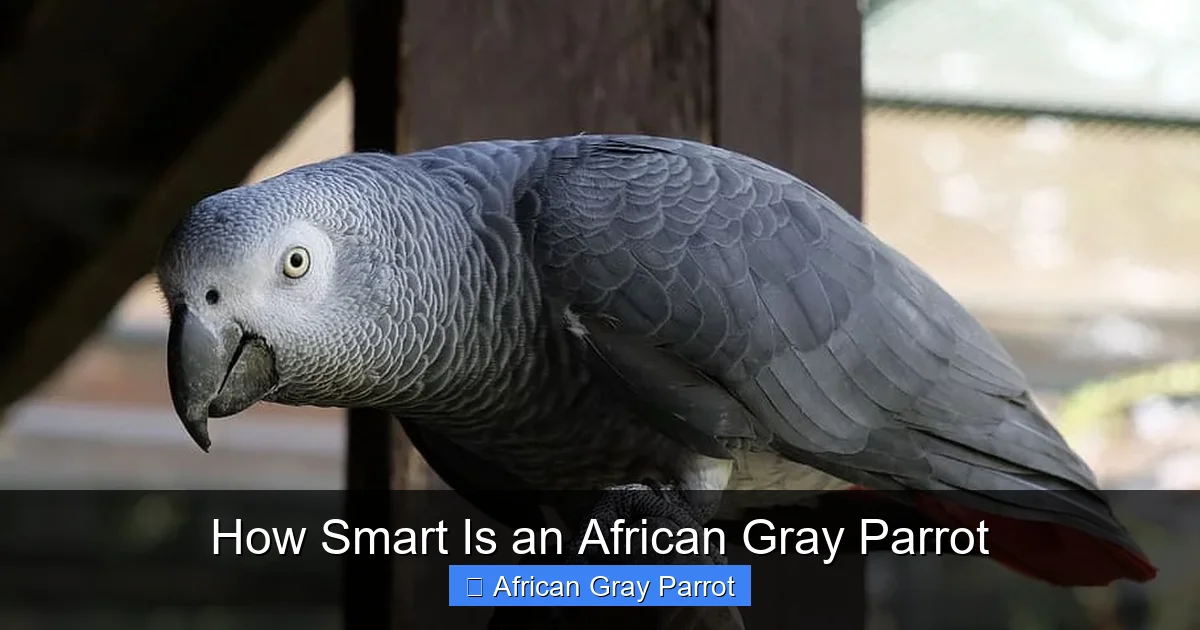
Visual guide about How Smart Is an African Gray Parrot
Image source: pangovet.com
Who Was Alex?
Alex stood for Avian Learning Experiment. He was a Congo African gray parrot purchased from a Chicago pet store when he was about one year old. Dr. Pepperberg did not pick a “special” bird. She wanted a random individual to prove the species had potential. Alex lived to be 31 years old. He died suddenly in 2007 from an arteriosclerosis event. His last words to Dr. Pepperberg were reportedly, “You be good. I love you.”
During his life, Alex learned to identify over 50 objects by name. He understood seven colors and five shapes. He grasped concepts like “bigger,” “smaller,” “same,” and “different.” He could count up to six items. He understood the concept of zero. That is an abstract mathematical concept many human children struggle with until age four or five.
What Alex Taught Us
The critical breakthrough was the training method. Dr. Pepperberg used the Model-Rival technique. Two humans interact in front of the bird. One acts as trainer, the other as model and rival for attention. The bird sees the social dynamic. It wants to participate. This mimics natural flock learning. It proved parrots learn best socially, not through rote repetition.
Alex did not just memorize associations. He demonstrated understanding. If shown a blue wooden square and a blue woolen triangle, he could answer “What’s same?” with “Color.” He could answer “What’s different?” with “Shape” or “Matter.” He could combine labels. He could request specific items. “Want nut.” “Want cork.” If given the wrong item, he would reject it and ask again.
Perhaps most stunning was his grasp of “none.” When presented with sets of objects and asked “How many?” for a color not present, Alex learned to say “None.” This showed he understood zero as a quantity, not just an absence. He also invented his own word for apple. He called it “banerry.” A blend of banana and cherry. He analyzed the taste and created a label. That is spontaneous language creation.
After Alex, Dr. Pepperberg continued work with Griffin and Athena. These birds replicate and extend Alex’s skills. Griffin can do inference by exclusion. He can deduce the location of a hidden treat by eliminating impossible options. This is logical reasoning. The body of work is vast. It proves African gray intelligence is real, repeatable, and profound.
Language and Communication Skills
When people ask how smart is an African gray parrot, they usually mean talking. The talking ability is legendary. But there is a massive difference between mimicry and communication. African grays do both. Understanding the difference is key to appreciating their intelligence.
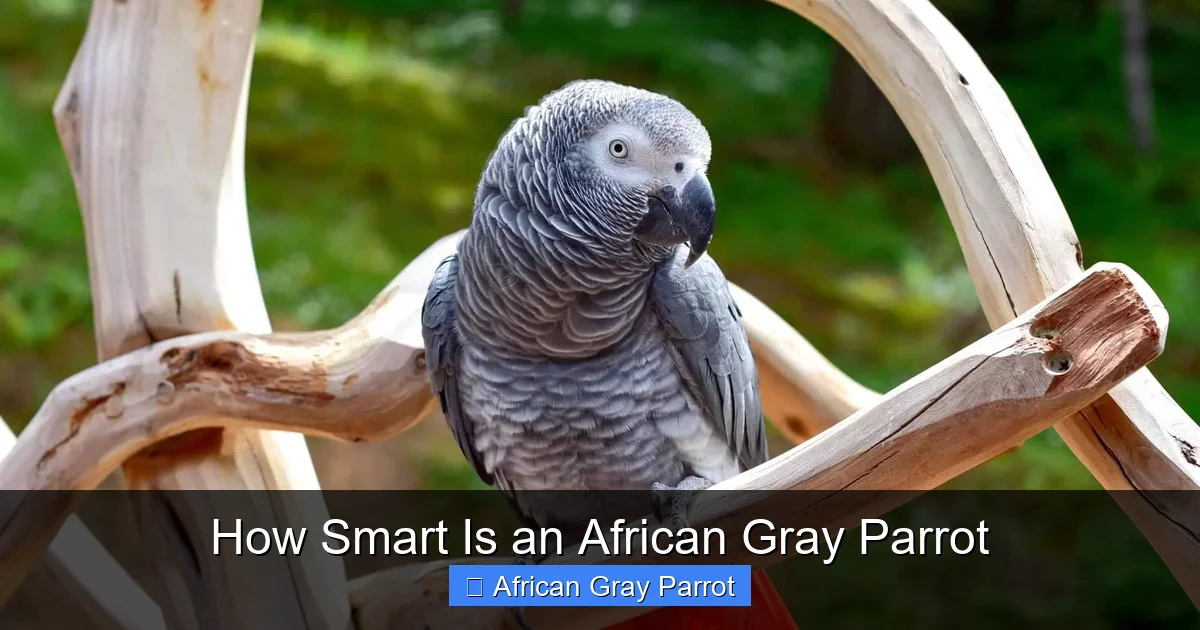
Visual guide about How Smart Is an African Gray Parrot
Image source: bubblypet.com
Vocabulary and Context
An average pet African gray learns 50 to 200 words. Exceptional birds reach 500 to 1000. The world record holder, a bird named Prudle, had a documented vocabulary of over 1,000 words. But vocabulary size is not the best metric. Contextual usage is.
A mimic repeats a sound because it gets a reaction. A communicator uses a word to achieve a goal. African grays routinely use words functionally. They label objects they want. They comment on events. They answer questions. They combine words into novel phrases. An owner drops a glass. The bird says, “Oh no, broken.” The bird sees a new toy. It says, “What’s that?” These are not trained responses. They are spontaneous applications of learned labels.
They also understand syntax to a degree. They recognize that word order changes meaning. “Tickle me” versus “Me tickle” might both be understood as a request. But they often develop their own grammar. “Want grape” is common. “Grape want” is rare. They pick up the statistical patterns of human speech.
Understanding Concepts
Beyond labeling, African grays grasp categories. They understand that “toy” applies to a ball, a block, and a ring. They understand “color” as a property separate from shape. Alex proved this rigorously. Pet owners see it daily. Show a gray a red car and a red ball. Ask “What color?” Many will say “Red.” Ask “What shape?” They might say “Ball” or “Round.” They are categorizing.
They also understand functional concepts. “Hot” means don’t touch. “Water” means bath or drink. “Bye-bye” means someone is leaving. They use these words predictively. An owner puts on shoes. The bird says “Bye-bye.” The bird has predicted the future based on a cue. That is advanced cognition.
Sound mimicry extends beyond words. They copy microwaves, phones, alarms, laughter, coughs, and other pets. They use these sounds contextually. A bird might mimic the microwave beep when hungry. It has learned the sound predicts food. It uses the sound to manipulate the owner. That is tool use. The tool is sound.
Problem-Solving and Tool Use
Language gets the glory. But problem-solving is where African gray intelligence shines brightest. In the wild, they face complex extraction problems. Hard nuts. Protected seeds. In captivity, they apply this talent to everything. Locks. Puzzles. Escape routes. The question how smart is an African gray parrot is answered every time one opens a “bird-proof” cage latch.
Puzzle Solving
Researchers test problem-solving with multi-access boxes. The box has food inside. It can be opened by pulling a lever, sliding a door, or flipping a lid. African grays explore all options. They learn the fastest method. They remember it weeks later. They innovate. If the lever is blocked, they immediately switch to sliding. This shows cognitive flexibility. They are not stuck on one routine.
String-pulling tests are classic. A treat hangs on a string. The bird must pull the string up, step on it, pull again. African grays master this quickly. They understand the connection between action and reward. They do not just yank randomly. They pull, hold, reach, repeat. It is a planned sequence.
Some studies test insight learning. The bird sees a problem. It stares. It does not trial-and-error. It solves it on the first try. This suggests mental simulation. The bird runs the solution in its head before acting. That is a hallmark of high intelligence.
Tool Use in Captivity and Wild
Tool use was once considered uniquely human. Then primates. Then corvids. Now parrots. African grays in captivity spontaneously use tools. They use sticks to scratch unreachable spots. They use feathers to sweep seeds closer. They use bottle caps as scoops. They use paper to soak up water and bring it to their beak.
A famous case involved a gray named Figaro. He was a Goffin’s cockatoo, not a gray. But African grays show identical abilities. Figaro broke off splinters from a wooden beam. He shaped them. He used them to rake in nuts outside his cage. He made different tools for different tasks. Short tools for close nuts. Long tools for far nuts. He manufactured tools. That is planning.
In the wild, tool use is rarer but documented. African grays have been observed using twigs to extract grubs. They use bark flakes to scrape fruit pulp. The behavior is not as common as in New Caledonian crows. But the capacity is there. Captivity reveals the latent potential. The brain is built for it.
Owners see this daily. A gray uses a feather to preen a hard-to-reach feather. It uses a toy part to unlock a cage latch. It drops a nut on a hard floor to crack it. It places the nut in a specific spot. It aims. It learns the best surface. This is engineering.
Emotional Intelligence and Social Cognition
Intelligence is not just logic and language. It is social. It is emotional. African grays are intensely social beings. Their emotional intelligence is a huge part of how smart is an African gray parrot. They read people. They read each other. They manipulate. They empathize. They grieve.
Empathy and Bonding
African grays form pair bonds that last a lifetime. In the wild, they stay with one mate. In captivity, they bond deeply with one person. This is not just imprinting. It is a complex social attachment. They show distress when separated. They show joy upon reunion. They preen their chosen human. They feed them regurgitated food. This is courtship behavior directed at a person.
They read human emotions uncannily well. If you are sad, a bonded gray may become quiet. It may cuddle closer. It may make soft contact calls. If you are angry, it may go silent. It may hide. If you are excited, it may scream and flap. It matches your energy. This is emotional contagion. It is a building block of empathy.
Some birds go further. They offer comfort. An owner cries. The bird wipes the tears with its beak. It makes a specific soft sound. It stays physically close. This looks like consolation behavior. Consolation is seen in apes, elephants, and dogs. Seeing it in a bird suggests deep social cognition.
Understanding Others’ Perspectives
Theory of mind is the ability to attribute mental states to others. To know that others see, know, or want different things than you do. It is a pinnacle of cognition. African grays show strong evidence of this.
In competitive tasks, a gray will hide food from a dominant bird. It waits until the other bird is not looking. It chooses a hiding spot behind a barrier. It understands the other bird’s visual perspective. “If he can’t see me, he doesn’t know.” That is level one perspective taking.
They also understand knowledge states. In the Alex studies, Alex would answer questions differently depending on what the questioner knew. If the trainer saw the object, Alex gave a short answer. If the trainer did not see it, Alex gave more detail. He tailored his communication to the listener’s knowledge. That is audience design. It is sophisticated pragmatics.
They manipulate attention. A gray wants a treat. It makes a sound the owner associates with a different need. The owner looks. The bird switches to “treat” request. It used a distraction. It understood the owner’s focus. It redirected it. That is tactical deception. Deception requires theory of mind.
What This Means for Pet Owners
Understanding how smart is an African gray parrot is not just academic. It is a care guide. Their intelligence creates specific needs. If you ignore them, the bird suffers. Behavioral problems erupt. Feather plucking. Screaming. Aggression. Self-mutilation. These are symptoms of a brilliant mind in a boring cage.
Mental Stimulation Needs
An African gray needs a job. In the wild, their job is survival. Foraging. Socializing. Navigating. Avoiding predators. In a cage, food is free. Predators are absent. The flock is often one human. The brain has nothing to do. It creates its own problems.
Foraging is the single best enrichment. Make the bird work for every calorie. Hide pellets in paper cups. Wrap nuts in cardboard. Use puzzle feeders. Scatter food in substrate. Rotate toys weekly. Novelty is crucial. A smart bird masters a toy in days. Then it is trash. You need a rotation system. Chew toys. Puzzle toys. Foot toys. Shreddable toys. Foraging toys. Social toys.
Training is mental exercise. Five minutes twice a day changes everything. Teach targeting. Teach colors. Teach shapes. Teach “put in.” Teach “bring.” Use positive reinforcement only. Clicker training works beautifully. The bird learns to learn. It burns mental energy. It strengthens your bond. It gives the bird agency.
Training Tips
Keep sessions short. Five to ten minutes. End on a win. Use high-value treats. Sunflower seeds. Pine nuts. Almond slivers. Be consistent with cues. “Step up” always means step up. “Down” means step down. Do not drill. Mix known behaviors with new ones. Variety prevents boredom.
Teach cooperative care. Train the bird to accept nail trims. Towel restraint. Carrier entry. Scale weighing. This reduces stress. It gives the bird control. A bird that chooses to step on a scale is a partner. A bird forced into a towel is a victim. Intelligence demands agency.
Social time is non-negotiable. Four hours minimum out of cage daily. On you. Near you. Playing. Talking. Just being. A gray left alone for eight hours while you work will develop issues. If you work long hours, this is not the pet for you. Consider two birds. But know that two birds may bond to each other, not you. There is no easy fix. The need is massive.
Environment matters. A large cage. Minimum 36x24x48 inches. Bigger is better. Multiple perch types. Rope. Wood. Platform. Swing. Natural branches. UV lighting. Full spectrum. It supports vision and vitamin D. A view of the outside. But not direct sun. Safety first.
Routine helps. But rigidity hurts. Vary the schedule slightly. Novelty within structure. A new food. A new toy. A new game. A new word. Keep the brain guessing. A guessing brain is a healthy brain.
Conclusion
So, how smart is an African gray parrot? The answer is humbling. They are not “smart for a bird.” They are smart, period. They reason. They speak with intent. They solve novel problems. They manufacture tools. They understand numbers. They read minds. They feel deeply. They love fiercely. They grieve genuinely.
The science is clear. African gray parrots possess a form of intelligence that converges with primates and cetaceans. It evolved independently. Different hardware. Similar software. This is convergent evolution at its most spectacular. It forces us to rethink what intelligence looks like. It forces us to rethink our relationship with other minds.
If you live with an African gray, you know this. You live with a toddler who never grows up. A toddler with a beak that crushes brazil nuts. A toddler who screams at 100 decibels. A toddler who lives for sixty years. It is exhausting. It is expensive. It is the most rewarding relationship you will ever have with an animal.
If you are considering one, think hard. Read this guide again. Talk to rescuers. Visit a sanctuary. Meet the birds. Hear the noise. See the mess. Feel the bite. Then decide. These beings deserve homes that understand them. Homes that challenge them. Homes that love them on their terms. Because they are not pets. They are people. Feathered, four-toed, brilliant people.
The next time your gray looks at you with that dark, knowing eye and says something perfectly timed, remember Alex. Remember the science. Remember the rainforest. You are looking at one of the most extraordinary minds on Earth. Treat it accordingly.
Frequently Asked Questions
Can African gray parrots do math?
Yes, African gray parrots demonstrate numerical competence. The famous parrot Alex could count up to six objects, understand the concept of zero, and perform simple addition tasks, showing mathematical abilities comparable to young children.
Do African gray parrots get bored easily?
Extremely. Their high intelligence requires constant mental stimulation. Without foraging opportunities, puzzles, training, and social interaction, they develop severe behavioral issues like feather plucking, screaming, and self-mutilation.
Can African gray parrots recognize themselves in a mirror?
Current research shows African grays do not pass the standard mirror self-recognition test. They typically react to their reflection as another bird, though they can learn to use mirrors as tools to locate hidden objects.
How does African gray intelligence compare to a human child?
Cognitive studies suggest African gray parrots possess reasoning and communication skills comparable to a 3 to 5-year-old human child, particularly in categorization, inference, and functional language use.
What is the best way to teach an African gray parrot to talk?
Use the Model-Rival method: have two people interact verbally while the bird watches, creating social motivation to participate. Speak clearly, use words in context, reward attempts, and keep sessions short and positive.
Are Congo and Timneh African grays equally intelligent?
Yes, both subspecies (Congo and Timneh) show equivalent cognitive abilities in research settings. Individual personality and early socialization play larger roles in observed intelligence than subspecies differences.