
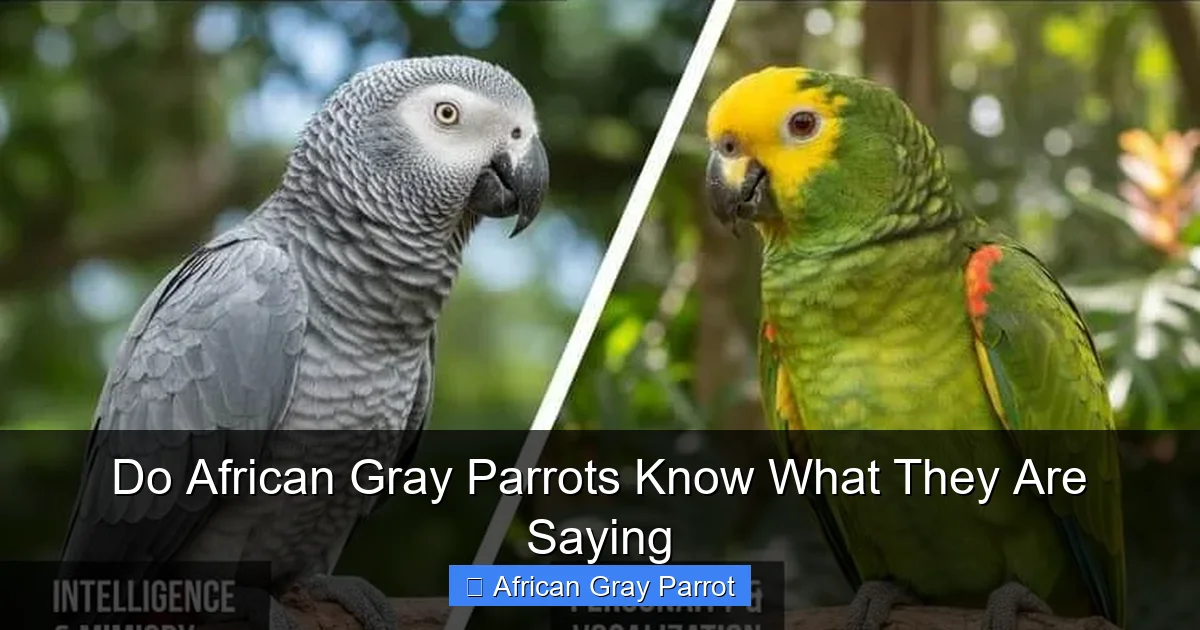
African Gray Parrots demonstrate remarkable cognitive abilities that go far beyond simple mimicry. Research shows these birds can associate words with meanings, understand concepts like shape and color, and even use language in context-appropriate ways.
If you have ever spent time around an African Gray Parrot, you have probably heard them say something that made you pause. Maybe they greeted you by name when you walked through the door. Maybe they asked for a nut right before snack time. Maybe they even said “I love you” in a moment that felt surprisingly genuine.
It raises a question that has fascinated bird lovers and scientists alike for decades. Do African Gray Parrots actually know what they are saying? Or are they just feathered tape recorders playing back sounds they have memorized? The answer sits somewhere in the middle, and it is more interesting than a simple yes or no.
Key Takeaways
- African Grays possess genuine comprehension: Studies confirm they understand word meanings, not just sounds.
- Alex the parrot proved advanced cognition: Dr. Irene Pepperberg’s work showed a parrot could identify 50+ objects, 7 colors, and 5 shapes.
- Context matters for language use: These parrots often use words appropriately in different situations.
- Training method affects comprehension: Model-rival training produces better understanding than rote repetition.
- Emotional intelligence plays a role: African Grays connect words with emotional states and social cues.
- Individual variation exists: Not all African Grays develop the same level of comprehension.
- Ongoing research continues: Scientists still debate the exact nature and limits of parrot language comprehension.
Quick Answers to Common Questions
What is do african gray parrots know what they are saying?
do african gray parrots know what they are saying refers to essential knowledge and techniques.
📑 Table of Contents
The Difference Between Mimicry And Meaning
Let us start with the basics. Mimicry is the ability to copy sounds. Many birds do this. Mockingbirds copy other birds. Lyrebirds copy chainsaws and camera shutters. African Grays copy human speech, microwave beeps, and phone ringtones with uncanny accuracy.
But mimicry alone does not equal understanding. A parrot can learn to say “hello” every time the phone rings without knowing that “hello” is a greeting. It is just a sound linked to a trigger. This is called associative learning. The bird learns that sound A happens when event B occurs.
True comprehension means the bird grasps the concept behind the word. It knows that “nut” refers to a specific edible object. It understands that “red” describes a color property shared by multiple items. It can apply a label to a new object it has never seen before because it understands the category.
How Scientists Test For Understanding
Researchers cannot just ask a parrot “do you know what that means?” They have to design clever experiments. The gold standard involves testing referential use. This means the bird uses a label to identify or request a specific item.
In a typical test, a researcher might hold up an object and ask “what’s this?” If the parrot says the correct label consistently across many trials with different objects, that suggests comprehension. But the real test comes with novel combinations. Can the bird identify a “blue triangle” it has never seen before because it knows “blue” and “triangle” separately?
Another key test is exclusion. If a parrot knows the labels for “nut,” “corn,” and “grape,” and you present a new food item with a new label, can the bird infer that the new label goes with the new item? This kind of fast mapping is a hallmark of human child language development.
The Limitations Of Simple Association
Critics argue that even impressive performance might just be complex conditioning. The bird learns that saying “red” when shown a red object gets a reward. Saying “blue” when shown a blue object gets a reward. This is still stimulus-response, not true symbolic thought.
To rule this out, researchers look for spontaneous, untrained language use. Does the bird combine words in new ways? Does it use words to comment on things, not just request them? Does it correct itself? These behaviors suggest the bird is manipulating symbols mentally, not just responding to cues.
Alex The Parrot: The Game Changer
No discussion of African Gray intelligence is complete without Alex. Alex was the subject of Dr. Irene Pepperberg’s thirty-year study at Harvard and Brandeis. His name stood for Avian Learning Experiment. What Alex did changed everything we thought we knew about bird brains.
Visual guide about Do African Gray Parrots Know What They Are Saying
Image source: wildbirdlady.com
When Dr. Pepperberg started in the 1970s, the scientific consensus was that birds were simple automata. “Bird brain” was an insult. Alex proved otherwise. By the end of his life, Alex could identify over fifty different objects. He knew seven colors. He knew five shapes. He understood concepts like bigger, smaller, same, and different.
Alex’s Most Striking Abilities
Alex did not just label things. He could answer questions about objects he had never seen before. Show him a blue wooden triangle and a green wooden triangle. Ask “what’s same?” He would say “shape.” Ask “what’s different?” He would say “color.” This requires abstract conceptual thinking.
He could count. Not just recite numbers. He could look at a tray with three blue blocks and two red blocks and answer “three” when asked “how many blue?” He understood the concept of zero, which is surprisingly advanced. Human children typically grasp zero around age four.
Alex also combined words creatively. He called an apple a “banerry” – a blend of banana and cherry. He had never been taught this word. He invented it because the apple shared properties with both fruits in his mind. This suggests he was categorizing based on features, not just memorizing labels.
The Model-Rival Training Method
How did Alex learn all this? Dr. Pepperberg used a technique called model-rival training. Two humans work with the bird. One acts as the trainer. The other acts as a model for the desired response and a rival for the trainer’s attention.
The trainer shows an object and asks the model “what’s this?” The model answers correctly. The trainer praises the model and gives them the object. The parrot watches. The parrot wants the object. The parrot wants the praise. So the parrot tries to say the word.
This mimics natural social learning. It uses the bird’s social drive. It is vastly more effective than simple repetition drills. The bird sees the word used in a social context with a clear function. This is likely why Alex developed comprehension while many pet parrots only develop mimicry.
Alex’s Legacy And Limitations
Alex passed away in 2007 at age thirty-one. His death was a huge loss. But his legacy lives on. Dr. Pepperberg continued her work with other African Grays, including Griffin and Athena. They have replicated many of Alex’s abilities.
Critics still point out limitations. Alex lived in a lab with intensive daily training. His vocabulary was around one hundred words. A typical five
Frequently Asked Questions
What is do african gray parrots know what they are saying?
do african gray parrots know what they are saying is an important topic with many practical applications.