
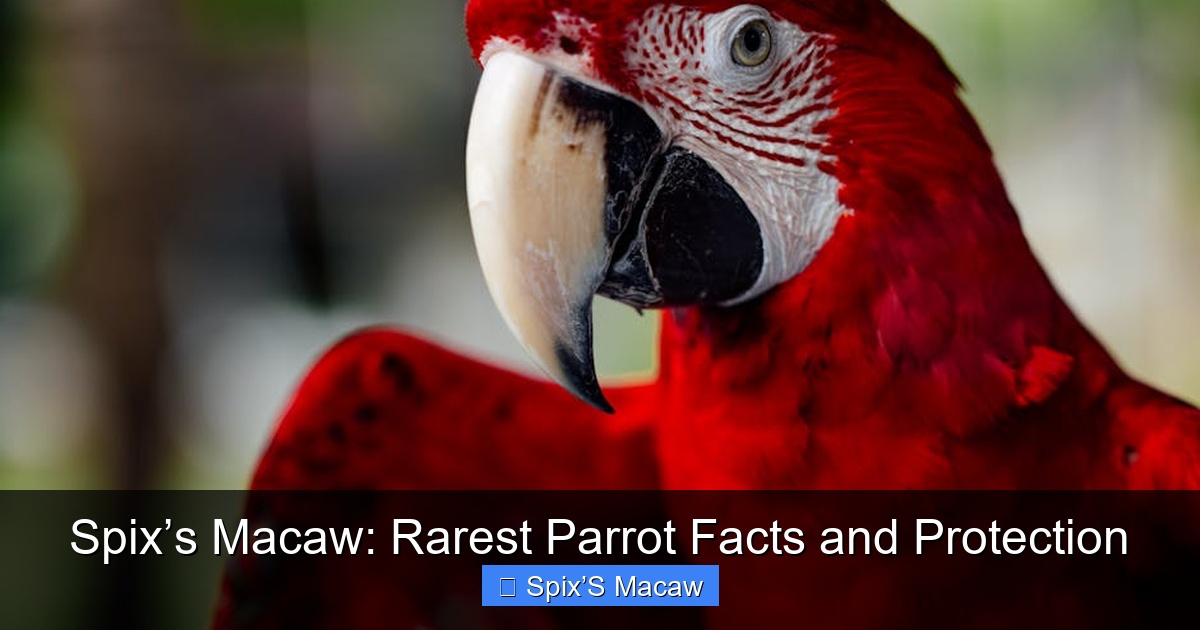
Featured image for this comprehensive guide about Spix’s Macaw
Spix’s Macaw: Rarest Parrot Facts and Protection
Category: Types of Parrots
Imagine a bird so vibrantly blue, so elusive, that its story became a global symbol of conservation, a testament to both human destruction and profound dedication. This is the tale of the Spix’s Macaw (Cyanopsitta spixii), often heralded as the rarest parrot on Earth, or more accurately, a species brought back from the brink of oblivion. For decades, its shimmering cerulean feathers and heartbreaking rarity captivated ornithologists, conservationists, and the public alike, especially after its star turn in the animated film “Rio.”
For context on other critically endangered parrots, like the Kakapo Parrot, learn how these unique birds are being protected.
But the real-life drama of the Spix’s Macaw is far more complex and compelling than any movie script. Once thought to be entirely extinct in the wild, this magnificent blue parrot now represents a fragile beacon of hope, thanks to monumental international efforts. Its journey from a dwindling wild population to a meticulously managed captive breeding program, and finally, a historic reintroduction into its native Brazilian Caatinga, is a powerful narrative of resilience, collaboration, and the unwavering commitment to preserving Earth’s biodiversity. Join us as we delve deep into the world of the Spix’s Macaw, uncovering its unique characteristics, understanding the factors that led to its near-disappearance, and exploring the groundbreaking work being done to secure its future.
📋 Table of Contents
- The Enigmatic Blue Jewel: Understanding Spix’s Macaw
- A History of Decline: The Road to Extinction in the Wild
- The Race Against Time: Heroic Conservation Efforts
- Back from the Brink: The Reintroduction Journey
- Challenges and Hope: Protecting the Future of Spix’s Macaw
- How You Can Help: Contributing to Spix’s Macaw Conservation
- Conclusion: A Blue Beacon of Hope
The Enigmatic Blue Jewel: Understanding Spix’s Macaw
The Spix’s Macaw is more than just a beautiful bird; it’s a unique branch on the tree of life, possessing distinct characteristics that set it apart. Named after the German naturalist Johann Baptist von Spix, who first collected a specimen in 1819, this parrot quickly became a subject of scientific fascination and, sadly, human exploitation.
Physical Characteristics: A Vision in Blue
At first glance, the most striking feature of the Spix’s Macaw is its exquisite coloration. Unlike its larger, more common blue cousins like the Hyacinth Macaw or Lear’s Macaw, the Spix’s Macaw exhibits a slightly muted, yet incredibly elegant, palette of blues:
| Feature | Description for Spix’s Macaw | Notes/Status |
|---|---|---|
| Scientific Name | Cyanopsitta spixii | Also known as the “Little Blue Macaw.” |
| Native Range | Northeast Brazil (Bahia state) | Endemic to specific gallery forests along seasonal rivers. |
| Conservation Status | Extinct in the Wild (EW) | Declared by IUCN in 2019; last known wild individual disappeared in 2000. |
| Global Population (Captive) | ~180-200 individuals | (As of 2023 estimate) Result of intensive international breeding programs. |
| Adult Size | ~55-57 cm (22-22.5 inches) | A medium-sized macaw, smaller than many other large macaw species. |
| Plumage Color | Dull blue overall, paler on head and underparts | Distinct from the vibrant blues of Hyacinth or Lear’s Macaws. |
- Head and Neck: A pale, ash-blue, often appearing greyish.
- Body: Gradually deepens to a vibrant, indigo-blue on the wings and tail.
- Facial Skin: A patch of dark grey, almost black, bare skin around the eyes, extending to the beak. This unique mask helps distinguish it from other blue macaws.
- Beak: Predominantly black, strong, and curved, perfectly adapted for cracking tough nuts and seeds.
- Size: It’s a medium-sized macaw, typically measuring around 55-57 cm (21-22 inches) from head to tail, with a wingspan of approximately 25-30 cm (10-12 inches).
- Weight: Generally weighs between 290-370 grams (10-13 ounces).
These subtle differences are crucial for identification, especially when considering other similarly colored macaws. The Spix’s Macaw is truly one of a kind.
Natural Habitat and Behavior: Life in the Caatinga
The historical range of the Spix’s Macaw was highly restricted, confined almost exclusively to a specific biome in northeastern Brazil: the Caatinga. This unique semiarid region, characterized by thorny scrubland, deciduous trees, and seasonal rivers, provided everything the Spix’s Macaw needed to thrive.
- Preferred Trees: They primarily nested in hollows of tall, mature Caraibeira (Tabebuia caraiba) trees, which often grew along seasonal riverbanks, particularly the São Francisco River. These trees offered vital shelter and protection.
- Diet: Their diet was specialized, consisting mainly of seeds, nuts, and fruits from various native plants of the Caatinga. Essential food sources included the seeds of the Pinhão (Jatropha pohliana) and the fruits of the Facheiro (Pilosocereus gounellei) cactus.
- Social Structure: While macaws are generally social, Spix’s Macaw pairs were known to be relatively solitary outside of breeding seasons, often seen foraging in small family groups rather than large flocks.
Their dependence on specific tree species and a specialized diet made them particularly vulnerable to habitat degradation. The Spix’s Macaw was, and still is, a creature deeply intertwined with its environment.
A History of Decline: The Road to Extinction in the Wild
The story of how the Spix’s Macaw reached the brink of extinction is a classic, albeit tragic, example of human impact on biodiversity. A combination of factors, each contributing to the species’ vulnerability, steadily eroded its wild population.
The Impact of Habitat Loss: Deforestation in the Caatinga
The primary driver of the Spix’s Macaw’s decline was the relentless destruction of its unique Caatinga habitat. The region around the São Francisco River, once teeming with life, underwent significant transformation:
- Agriculture: Extensive areas were cleared for cattle ranching and the cultivation of crops like sisal and maize. This eliminated critical foraging grounds and nesting sites.
- Logging: The favored Caraibeira trees, essential for nesting, were often felled for timber or to make way for agriculture, directly removing the parrots’ homes.
- Dams and Water Diversion: Water projects, while aimed at human development, altered the natural water flow of the São Francisco River, impacting the gallery forests where the macaws thrived.
With fewer suitable trees and a dwindling food supply, the remaining Spix’s Macaws faced immense pressure, making them more susceptible to other threats.
The Scourge of Illegal Trapping: The Pet Trade’s Role
As the Spix’s Macaw became rarer, its desirability on the illegal exotic pet market soared. This created a devastating feedback loop:
- High Demand: The allure of owning such a beautiful and rare bird led to exorbitant prices, incentivizing poachers.
- Intensive Trapping: Trappers targeted nests, stealing chicks, and captured adult birds, decimating breeding pairs. This intensified as the population shrunk, making each loss more critical.
- Genetic Bottleneck: The removal of individuals further reduced the genetic diversity of the already small wild population, impairing its ability to adapt and survive.
By the late 20th century, the numbers were so critically low that it became nearly impossible to find a Spix’s Macaw in its natural environment. The last known wild individual, a male, disappeared in the year 2000, confirming the species’ status as extinct in the wild.
Other Contributing Factors
While habitat loss and the illegal pet trade were the dominant threats, other factors played a role:
- Hunting: Although not their primary target, some macaws were occasionally hunted for food or feathers.
- Introduced Species: Domestic animals like cats and rats, introduced by human settlements, could prey on eggs and chicks.
- Disease: Small, isolated populations are more vulnerable to diseases spreading rapidly and causing significant losses.
The cumulative effect of these pressures led to the grim reality of the Spix’s Macaw vanishing from its ancestral home.
The Race Against Time: Heroic Conservation Efforts
Even as the wild population dwindled, a desperate, yet determined, effort began to save the Spix’s Macaw through captive breeding. This monumental task required unprecedented international collaboration and dedication.
The Spix’s Macaw Release Project: Early Attempts and Lessons Learned
Initial attempts to save the species focused on establishing a captive breeding program and, eventually, a release project. The Al Wabra Wildlife Preservation (AWWP) in Qatar, along with the Association for the Conservation of Threatened Parrots (ACTP) in Germany, became central to these efforts. These organizations, among others, held the majority of the remaining birds. Early reintroduction attempts in the late 1990s, before the species was fully declared extinct in the wild, faced significant challenges and provided crucial lessons that would inform future strategies.
International Collaboration: A Global Rescue Mission
Saving the Spix’s Macaw was not a task for a single nation or organization. It required a global alliance:
- Brazilian Government: Through agencies like ICMBio (Chico Mendes Institute for Biodiversity Conservation), Brazil took a leading role in habitat protection and coordination.
- ACTP (Germany): Became a key player in the captive breeding program, providing scientific expertise and managing a significant portion of the captive flock.
- Al Wabra Wildlife Preservation (Qatar): Another critical partner, contributing extensive resources and expertise to the captive breeding program.
- Private Collections: A few private collectors, who had legally acquired birds decades earlier, voluntarily contributed their birds to the breeding program, understanding the importance of genetic diversity.
- International Ornithological Community: Scientists, veterinarians, and conservationists from around the world shared knowledge and resources.
This unprecedented level of cooperation was essential for overcoming political, logistical, and scientific hurdles. It highlighted that some conservation challenges are too great for any single entity to tackle alone.
The Power of Captive Breeding: A Meticulous Program
The captive breeding program for the Spix’s Macaw is a triumph of avian science and dedication. Starting with a tiny gene pool, scientists meticulously managed the breeding of individual birds:
- Genetic Management: Careful genetic analysis was performed on every bird to ensure the most diverse and viable pairings, minimizing inbreeding and maximizing genetic health.
- Specialized Care: The macaws required highly specialized diets, environments mimicking their natural habitat, and vigilant veterinary care.
- Artificial Incubation and Hand-Rearing: In many cases, eggs were artificially incubated, and chicks hand-reared to increase survival rates, especially in the early, critical stages.
- Population Growth: From a mere handful of individuals, the captive population slowly but steadily grew. By 2018, the global captive population exceeded 160 individuals, a monumental achievement that paved the way for reintroduction.
This painstaking work laid the foundation for the ultimate goal: returning the Spix’s Macaw to its ancestral home. The success of this program demonstrates the critical role of zoos and specialized breeding facilities in preventing species extinction.
Back from the Brink: The Reintroduction Journey
The year 2022 marked a pivotal moment in the history of the Spix’s Macaw: its return to the wild. This wasn’t a simple release; it was a carefully orchestrated, multi-year process designed to give these captive-bred birds the best chance of survival.
Preparing for the Wild: Training and Acclimatization
Before any birds could be released, extensive preparations were undertaken:
- Return to Brazil: In 2020, 52 Spix’s Macaws were flown from Germany to Brazil, a journey that itself was a logistical feat.
- Acclimatization Facility: A state-of-the-art acclimatization facility was built in Curaçá, Bahia, within the Spix’s Macaw Wildlife Refuge. Here, the birds were housed in large, outdoor aviaries.
- Wild Training: The macaws underwent a rigorous training program to hone their natural instincts, which might have dulled in captivity. This included learning to forage for natural foods, recognizing predators (using models and trained raptors), and navigating their environment.
- Companion Macaws: A small number of Lear’s Macaws (a closely related species) were introduced into the aviaries. These “teacher” birds helped the Spix’s Macaws learn wild behaviors and provided social interaction crucial for flock formation.
This intensive preparation was vital, acknowledging that captive-bred animals often lack the survival skills of their wild counterparts. It was about giving them a fighting chance.
The Historic Return: Details of the 2022 Reintroduction
On June 11, 2022, after decades of absence, the first group of eight Spix’s Macaws was released into the Caatinga, within the protected Spix’s Macaw Wildlife Refuge and Environmental Protection Area. This was followed by more releases, bringing the total to 20 birds by the end of 2022. Key aspects of the reintroduction included:
- Soft Release: The birds were released from an open aviary, allowing them to come and go as they pleased, gradually exploring their new surroundings while still having access to food and shelter from the facility.
- GPS Trackers: Each released Spix’s Macaw was fitted with a small GPS tracker, enabling continuous monitoring of their movements, foraging habits, and interactions.
- Supplemental Feeding: Initial supplemental feeding stations were provided to ensure the birds had a reliable food source as they learned to forage independently.
The sight of these magnificent blue parrots once again soaring over the Caatinga was an emotional and historic moment for everyone involved, a symbol of hope for the entire conservation community.
Monitoring and Support: Post-Release Care
The reintroduction is an ongoing process, requiring continuous monitoring and support:
- Daily Observations: A dedicated team of biologists and local community members track the birds daily, observing their behavior, health, and social dynamics.
- Health Checks: Regular health checks are performed, and interventions are made if a bird shows signs of distress or injury.
- Predator Management: Efforts are made to manage potential threats from natural predators while allowing the macaws to learn essential predator avoidance skills.
The goal is to build a self-sustaining wild population of Spix’s Macaws, but this will take many years of diligent effort and adaptation.
Challenges and Hope: Protecting the Future of Spix’s Macaw
While the reintroduction of the Spix’s Macaw is a monumental success, the journey is far from over. Significant challenges remain, but so does the unwavering hope and commitment to protect this incredible species.
Ongoing Threats in the Wild
Even within protected areas, the reintroduced Spix’s Macaws face several threats:
- Predation: Natural predators like raptors and wild cats are a reality, and the captive-bred birds need to fully develop their evasion skills.
- Human Disturbance: Despite protection, illegal activities like poaching and unauthorized entry into the refuge still pose risks.
- Habitat Integrity: The Caatinga remains vulnerable to climate change and human activities outside the protected zones, which could impact the long-term viability of the habitat.
- Diseases: Exposure to diseases present in wild bird populations is a constant concern for a species with a relatively small, genetically similar population.
Genetic Diversity Concerns: Managing the Captive Population
Despite the careful management, the entire global population of Spix’s Macaws originates from a very small number of founders. This genetic bottleneck presents long-term challenges:
- Inbreeding: The risk of inbreeding depression, leading to reduced fertility and health, is a constant concern.
- Adaptability: Limited genetic diversity can reduce the species’ ability to adapt to environmental changes, new diseases, or unforeseen challenges.
Ongoing genetic monitoring and careful breeding plans for the remaining captive population are crucial to maintain maximum diversity for future releases.
Community Engagement: The Vital Role of Local People
One of the most powerful aspects of the Spix’s Macaw conservation project is the involvement of local communities. The success of the reintroduction hinges on their support and understanding:
- Education and Awareness: Programs are in place to educate local residents about the importance of the Spix’s Macaw and its role in the ecosystem.
- Economic Opportunities: The project provides employment opportunities, fostering a sense of ownership and direct benefit from conservation efforts.
- Anti-Poaching Efforts: Local community members are often the first line of defense against illegal poaching, reporting suspicious activities and serving as guardians of the refuge.
Empowering the communities living alongside the Spix’s Macaw is perhaps the most sustainable long-term strategy for its protection.
Key Milestones in Spix’s Macaw Conservation
Here’s a brief overview of critical dates in the fight to save the Spix’s Macaw:
| Year | Event/Milestone | Significance |
|---|---|---|
| 1819 | First specimen collected by Johann Baptist von Spix. | Official scientific discovery of the species. |
| 1980s | Rapid decline of wild population due to habitat loss and trapping. | Species enters critical endangered status. |
| 1990 | Approximately 15 birds left in the wild. | Intensified conservation efforts begin. |
| 2000 | Last known wild Spix’s Macaw disappears. | Species declared extinct in the wild. |
| 2000s-2010s | Intensive captive breeding program by ACTP, AWWP, and others. | Global captive population steadily grows. |
| 2018 | Global captive population reaches over 160 individuals. | Paves way for reintroduction planning. |
| 2020 | First group of 52 Spix’s Macaws returned to Brazil. | Critical step for acclimatization. |
| June 2022 | First eight Spix’s Macaws reintroduced into the Caatinga. | Historic moment, species returns to the wild. |
| Dec 2022 | Total of 20 Spix’s Macaws released into the wild. | Building the foundational wild population. |
How You Can Help: Contributing to Spix’s Macaw Conservation
The story of the Spix’s Macaw is a powerful reminder that every species matters, and that collective action can make a difference. Even if you’re not a scientist or living in Brazil, there are meaningful ways you can contribute to the ongoing efforts to protect the rarest parrot and other threatened species.
Support Reputable Conservation Organizations
Financial support and awareness are crucial for the long-term success of conservation projects:
- Donate: Organizations like the ACTP (Association for the Conservation of Threatened Parrots), ICMBio (Brazil), and local Brazilian NGOs are on the front lines. Your donations directly fund fieldwork, habitat protection, research, and breeding programs.
- Volunteer: If you have the skills and time, consider volunteering with conservation groups, either locally or internationally.
- Spread the Word: Share the story of the Spix’s Macaw on social media, with friends and family. Increased awareness generates more support and understanding.
Spread Awareness and Education
Knowledge is power. The more people understand the threats to biodiversity and the potential for successful conservation, the better:
- Learn More: Educate yourself about endangered species and the ecosystems they inhabit.
- Advocate: Support policies and initiatives that protect natural habitats and combat illegal wildlife trade.
- Visit Zoos and Sanctuaries: Many accredited zoos play a vital role in captive breeding and public education. Learn about their conservation programs.
Be a Responsible Pet Owner
The illegal pet trade was a major factor in the Spix’s Macaw’s decline. You can help by ensuring your actions don’t inadvertently fuel such trades:
- Never Buy Wild-Caught Birds: Always ensure any pet parrot or exotic animal comes from a reputable, legal breeder, not from the wild.
- Research Before You Buy: Understand the origins and legal status of any exotic pet you consider.
- Report Illegal Activity: If you encounter suspicious activity related to wildlife trafficking, report it to the authorities.
Make Sustainable Choices
Our everyday consumer choices can have a far-reaching impact on habitats around the globe:
- Sustainable Products: Choose products that are certified sustainable, such as shade-grown coffee, sustainably sourced timber, and products that avoid palm oil (a major driver of deforestation in other regions).
- Reduce Your Footprint: Minimize waste, conserve energy, and support companies with strong environmental ethics.
- Eco-Tourism: If you travel, choose responsible eco-tourism operators who prioritize conservation and benefit local communities.
By taking these steps, you become an active participant in the global effort to protect not just the Spix’s Macaw, but all of Earth’s precious biodiversity. Every little bit helps to ensure that future generations can witness the beauty of these magnificent creatures in their natural habitats.
Conclusion: A Blue Beacon of Hope
The saga of the Spix’s Macaw is a poignant narrative that encapsulates the challenges and triumphs of modern conservation. From the brink of total extinction, reduced to a handful of individuals in captivity, this magnificent blue macaw has defied the odds. Its journey back to the wild, a testament to unwavering international collaboration and dedicated scientific effort, stands as a powerful symbol of hope.
The successful reintroduction of the Spix’s Macaw into the Caatinga is not merely about saving one species; it’s a blueprint for what humanity can achieve when it unites for a common ecological cause. It reminds us that even for the rarest parrot, a future is possible. However, this future remains fragile, requiring ongoing vigilance, sustained funding, and the continued support of local communities and a global audience. The vibrant blue feathers of the Spix’s Macaw now soaring over Brazil are more than just a beautiful sight; they are a living, breathing promise that with dedication and passion, we can heal the wounds we inflict upon nature and protect the invaluable diversity of life on Earth. Let the story of the Spix’s Macaw inspire us all to act, ensuring that its call echoes through the Caatinga for generations to come.
Frequently Asked Questions
What is the Spix’s Macaw and why is it so famous?
The Spix’s Macaw (Cyanopsitta spixii) is a critically endangered, striking blue parrot native to Brazil. It gained global fame and public attention due to its extreme rarity and the dedicated, decades-long international efforts to save it from extinction.
Why is the Spix’s Macaw considered one of the rarest parrots?
The Spix’s Macaw’s extreme rarity is primarily due to habitat destruction, specifically the deforestation of its gallery forest home along riverbanks in Brazil. Illegal trapping for the pet trade also severely depleted its wild population to the point of extinction.
Is the Spix’s Macaw extinct in the wild, or can it still be found?
The Spix’s Macaw was declared extinct in the wild in 2000. However, thanks to dedicated conservation efforts and a successful captive breeding program, reintroduction efforts have recently begun in its native habitat, offering renewed hope for its return to the wild.
Where did the Spix’s Macaw originally live, and what was its habitat like?
The Spix’s Macaw was historically found only in a specific dry Caatinga region of northeastern Brazil, particularly along the São Francisco River. It favored gallery forests characterized by Caraiba trees, which provided essential nesting sites and food sources.
What does the Spix’s Macaw look like and what makes it unique?
The Spix’s Macaw is a medium-sized parrot, reaching about 55-57 cm (22-22.5 inches) in length, known for its beautiful graduated shades of blue plumage. It has a paler blue head, darker blue wings, and a gray-black beak, with a distinctive bare facial patch around its eyes.
What are the main conservation efforts focused on protecting the Spix’s Macaw?
Extensive international conservation efforts for the Spix’s Macaw include a highly successful captive breeding program which has grown the population from a handful of birds. Reintroduction projects, habitat restoration, and community engagement in Brazil are crucial for establishing a self-sustaining wild population.